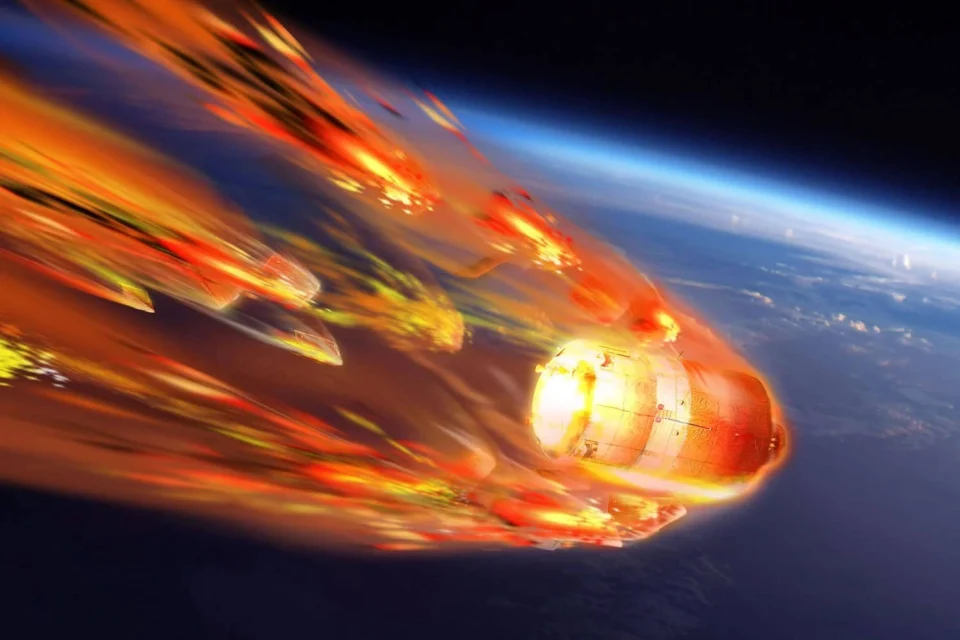
The Launch and Mission of Kosmos 482In 1972, the Kosmos 482 spacecraft was launched by the Soviet Union with the ambitious goal of reaching Venus. Unfortunately, due to a propulsion failure, it never achieved the necessary velocity for a Venusian orbit. As a result, the spacecraft has spent the past 53 years in Earth‘s orbit and is now preparing for an uncontrolled re-entry into our atmosphere.Mission Failure and Current StatusLaunched from the Baikonur Cosmodrome in Kazakhstan on March 31, 1972, Kosmos 482 was part of the Soviet Union’s efforts to explore Venus. However, a critical engine malfunction prevented it from escaping Earth’s gravitational pull. While smaller fragments re-entered and disintegrated shortly after launch, larger components have remained in orbit. The spacecraft, including both its carrier vehicle and landing probe, weighs approximately 500 kg.Re-Entry Predictions and Potential ImpactMarco Langbroek, an expert satellite tracker from the Netherlands, anticipates that Kosmos 482 will re-enter Earth’s atmosphere by the second week of May. However, due to the Sun’s increased activity causing atmospheric expansion, predicting an exact re-entry date is challenging. This expansion accelerates the orbital decay of space debris, potentially hastening the probe’s return.Surviving Re-EntryUnlike typical space debris, Kosmos 482 was engineered to withstand the harsh conditions of Venus’ atmosphere, which means it might not fully burn up upon re-entry. As a result, there is a possibility that some fragments could survive and reach Earth’s surface. However, predicting the exact impact location is currently impossible due to variables like atmospheric friction and orbital motion. Nevertheless, it is expected that any surviving debris will most likely fall into the ocean.
Kosmos 482: The Soviet Venus Probe Set to Return to Earth After 53 Years
Discover the journey of Kosmos 482, a Soviet Venus probe, as it makes its unexpected return to Earth after 53 years in space.
 YazanSigorta Haber
Yayınlandı Güncellendi 2 dk okuma

YAZAR
Sigorta Haber
Finans ve ekonomi alanında uzman. Piyasa analizleri, yatırım stratejileri ve makroekonomik gelişmeler üzerine içerikler üretir.
Yazar profili ve tüm yazıları