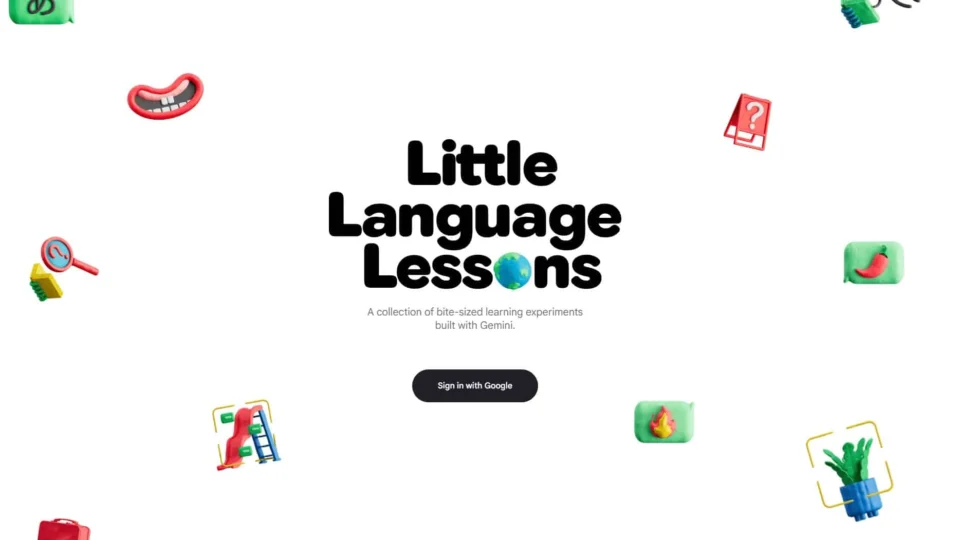
Overview of Google‘s New Language Learning InnovationsGoogle has introduced a trio of innovative AI-driven tools designed to enhance language acquisition, making it more intuitive and customized for users. These tools are powered by Gemini, Google‘s advanced multimodal language model, and they focus on providing practical solutions for everyday language use. Google’s initiative may be a strategic move to offer an alternative to the widely-used language app, Duolingo.Practical and Everyday Language SolutionsThe first tool, Tiny Lesson, offers targeted vocabulary and grammar recommendations tailored to real-life scenarios. For instance, if a user is dealing with a situation like “locating a missing passport,” the tool suggests relevant phrases and sentence structures such as “I don’t know where I lost it” or “I want to report it to the police,” facilitating effective communication in practical contexts.Recognizing that many language learners initially acquire only formal, textbook language, Google has developed Slang Hang to address this gap. This feature introduces users to colloquial expressions and natural dialogues typical of local interactions. It might present a conversation between a street vendor and customer or a casual chat between long-lost friends on public transport. By hovering over unfamiliar terms, users can instantly understand their meanings.The third tool, Word Cam, enables users to photograph their environment and learn the foreign language names of objects around them. For example, capturing an image of a window not only teaches the word “window” but also introduces related vocabulary like “blinds,” broadening the user’s linguistic repertoire.Support for Turkish and Other LanguagesGoogle’s AI language learning tools are available in a range of languages, including Arabic, Chinese (for China, Hong Kong, and Taiwan), English (for Australia, the UK, and the USA), French (for Canada and France), German, Greek, Hebrew, Hindi, Italian, Japanese, Korean, Portuguese (for Brazil and Portugal), Russian, Spanish (for Latin America and Spain), and Turkish. These experimental tools are accessible through Little Language Lessons on Google Labs.
Google Unveils AI-Powered Language Learning Tools
Explore Google's new AI-driven tools enhancing language learning with innovative features for personalized and interactive experiences.
 YazanSigorta Haber
Yayınlandı Güncellendi 2 dk okuma

YAZAR
Sigorta Haber
Finans ve ekonomi alanında uzman. Piyasa analizleri, yatırım stratejileri ve makroekonomik gelişmeler üzerine içerikler üretir.
Yazar profili ve tüm yazıları