
Georgia’s Fierce Tradition of Lelo Burti
Clearing a path through the crowd, a broad-shouldered priest clad in a black cassock marches forward, balancing a thick leather ball filled with soil and wine on his head. In moments, he disappears into the mass and fires a shotgun skyward, setting off an eruption of shouts and energy. As dust rises, bodies clash and feet skid over the pavement, testing endurance and spirit in sudden, explosive charges. This chaos marks the beginning of lelo burti, also known as ‘field ball’, a yearly match between two nearby villages in western Georgia, about 45 minutes from Kutaisi. Played every Orthodox Easter Sunday, it’s more a ritual than a sport. The contest ends only when one side pushes the heavy ball into a stream near their opponent’s village. Once victory is declared, the ball is laid on a grave to honour the departed.
With roots reaching back to at least the 12th century, lelo burti is Georgia’s raw and ancient counterpart to rugby. Witnessing it last Easter, I stood amazed that such a powerful, symbolic custom still thrives — and that it remains so close to modern Kutaisi, where I was staying. Since 2016, when low-cost airline Wizz Air made the city its Georgian base, Kutaisi has quietly grown into one of the country’s main entry points. Though many travellers still see it as a stopover, its changing infrastructure and new experiences suggest it is becoming a destination in its own right.

Kutaisi Emerges as a Distinct Destination
In the past year alone, Georgia welcomed a record 5.5 million visitors, with over a quarter entering through Kutaisi Airport. Still, only some chose to linger. Hotel occupancy outside Tbilisi remains around 35 percent, partly reflecting the shift in tourism patterns. Before the pandemic, most travellers came from the EU and the UK, but recent years have seen surges from neighbouring countries, concentrating visitors in Tbilisi and the Black Sea resorts.
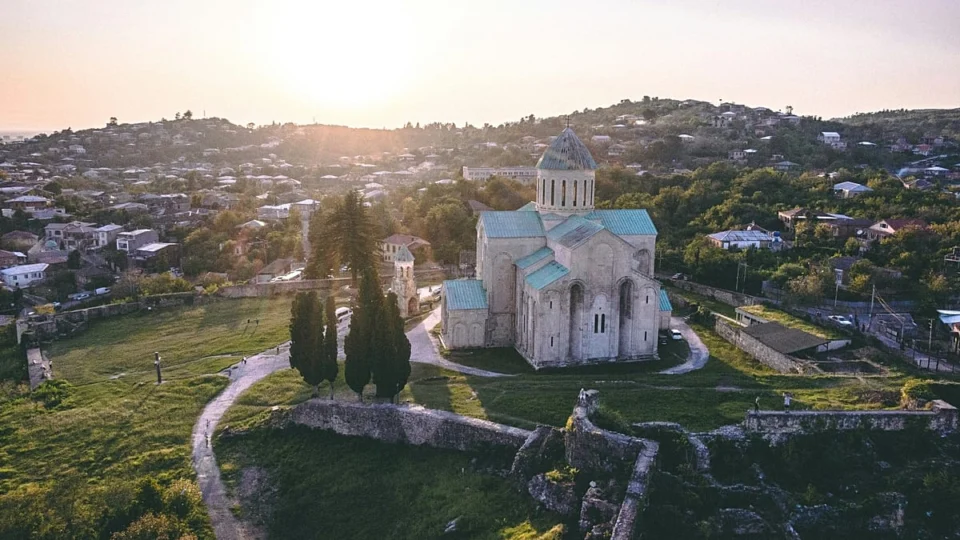
Amid such imbalance, only a handful of foreigners attended the lelo burti match last year — local media excluded. Among them was Emily Lush, travel writer and founder of Wander-Lush, who lives in Kutaisi and champions its unique charm. For Lush, Kutaisi offers what larger Georgian cities lack. “It’s a very liveable place,” she says. “Compared with Tbilisi or Batumi, it’s compact, intimate, and community-driven.” Traffic is light, and everything feels within reach. Landmarks such as the UNESCO-listed Bagrati Cathedral, the old Jewish and Catholic quarters, and the lively Green Bazaar enrich the walkable cityscape.
“Kutaisi is one of the world’s oldest continuously inhabited cities,” Lush adds. “Its layers of history reach far beyond its cathedrals and architecture.” Few visitors realize it was once the heart of Georgia’s punk rock scene during the 1990s. Fresh venues like Riff Raff, which opened in late 2023, continue that creative spirit. Wine bars like Wild and Amber Wine draw the city’s artists and innovators, while new restaurants appear constantly.
A Gateway to Western Georgia’s Natural Wonders
With its accessibility and ease of travel, Kutaisi serves as a perfect base for exploring western Georgia. Within hours, travellers can reach Svaneti’s stone tower villages, the forested trails of Racha, the coastal city of Batumi, and the culinary heartlands of Guria and Samegrelo. “The location is unmatched,” Lush notes. “Railway connections make reaching the capital or the western regions simple.”
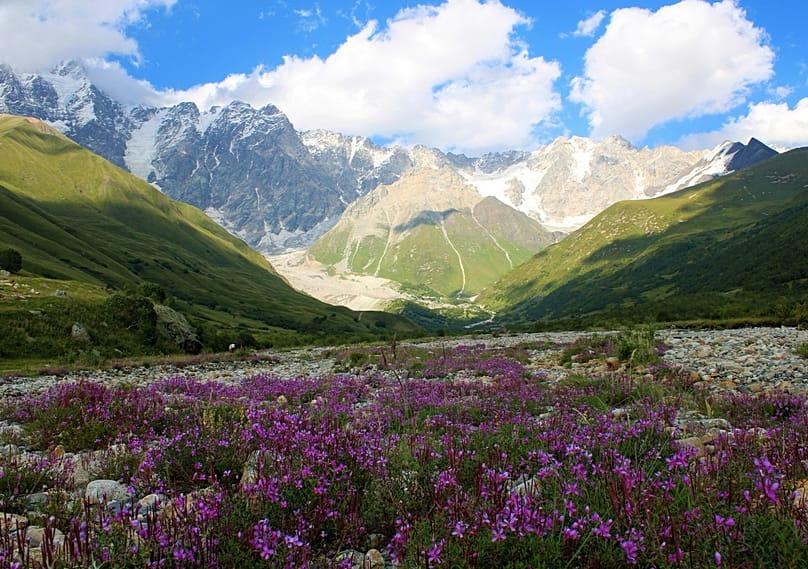
In Svaneti particularly, Kutaisi’s influence shines. Once envisioned by former president Mikheil Saakashvili as “a Switzerland in the Caucasus”, it’s now far more reachable. The renovated Zagari Pass between Kutaisi and Svaneti—what Lush calls “one of Georgia’s most epic drives”—and the newly paved route from Mestia to Ushguli have boosted accessibility for both hikers and winter sports lovers. The four-day hike from Mestia to Ushguli, threading through medieval landscapes, has become a favourite. During winter, ski areas like Hatsvali and Tetnuldi offer snow without the crowds of Gudauri.
Imereti’s Rising Status in Georgian Wine
South of Kutaisi lies the lush wine region of Imereti, a vivid patchwork of vineyards. Though Kakheti remains Georgia’s most famous wine-producing area, Imereti is gaining recognition for its crisp whites and sparkling varieties, many fermented in clay vessels following ancient traditions. Unlike Kakheti’s fuller, tannic wines, Imereti’s are lighter and more refreshing — a reflection of its wetter, greener climate and limestone-rich soil. Here, winemakers typically use smaller clay amphorae, called churi, and most production remains family-run.
Visitors are often welcomed into home gardens to share plates of Imereti-style khachapuri alongside countless glasses of locally made wine. “Wine is part of every key moment in life — it’s not simply a drink,” explains Baia Abuladze of Baia’s Wines, a family estate in Bagdati, just 20 minutes from Kutaisi. “Almost every household has its own small cellar.” Her winery, internationally acclaimed and visited by travellers from the US to Australia, offers long, sunlit lunches overlooking vines against the Lesser Caucasus, before guests return to boutique lodgings like Communal in Kutaisi.
“More travellers are realizing that western Georgia holds its own magic — its green scenery, calm rhythm, and incredible food and wine,” Abuladze says. “We host more guests each season, yet it never feels crowded.” Kutaisi may never become overrun by tourists, but it is steadily proving itself a destination worth more than a passing glance. Whether drawn by its fierce traditional games, serene vineyards, or evening strolls along the Rioni River, visitors are discovering a city rich in life, history, and hospitality.