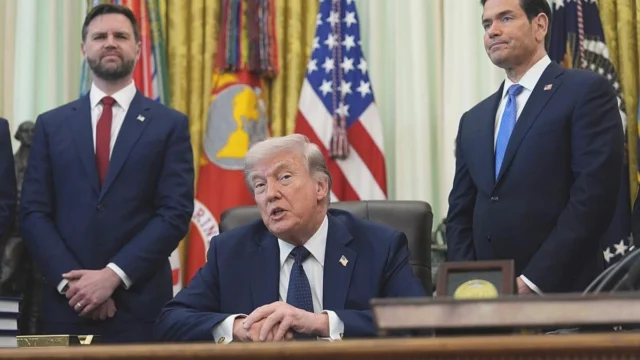
Understanding Legal Resistance to Presidential PoliciesThe legal opposition to President Donald Trump’s policies has been vigorous, with over 120 lawsuits initiated since January 20, targeting his executive orders and policy decisions. These legal challenges navigate through the judiciary, making it essential to comprehend the federal court system’s structure to predict how these cases may progress.The Structure of the Federal Court SystemArticle III of the U.S. Constitution establishes the Supreme Court, along with inferior Courts as Congress may establish. It also stipulates that judges shall serve during periods of good behavior. The federal judiciary comprises three primary levels: district courts (trial courts), circuit courts (first level of appeal), and the Supreme Court (final appellate authority). The United States hosts 94 district courts, 13 circuit courts, and one Supreme Court.For a court to hear a case, it must have personal jurisdiction (authority over the parties), subject matter jurisdiction (authority over the issue), and proper venue (correct geographic location). Unlike state courts with broad authority, federal courts have limited jurisdiction, meaning they can only hear cases authorized by the Constitution or federal law. Each lawsuit against the Trump administration raises a federal question, granting federal courts subject-matter jurisdiction.The Role of District and Circuit CourtsEach district court has at least one U.S. district judge appointed by the president and confirmed by the Senate for life. Plaintiffs losing at the district level can appeal to a federal appellate court. Circuit courts, or appellate courts, hear appeals from district courts within their geographical boundaries. For instance, the Fifth Circuit covers Louisiana, Mississippi, and Texas.Each circuit has multiple judges, ranging from six to 29, with appeals initially heard by a panel of three judges. Parties submit briefs arguing whether the trial court’s decision should be affirmed or reversed. After briefs, oral arguments are scheduled where attorneys present their cases and respond to judges’ queries. Occasionally, a full court may hear a case in an en banc session, with the Ninth Circuit using a modified en banc process due to its size.A circuit court’s decision binds all lower courts within that circuit, though other circuits are not bound by it. Generally, a case can only be appealed post a final decision, but some issues may be appealed through an interlocutory appeal.Appealing to the Supreme CourtParties can appeal a circuit court’s decision to the U.S. Supreme Court by filing a writ of certiorari, requesting the court’s review. The Supreme Court is not obligated to take the case, usually denying most petitions and granting review in under 1% of appeals. If cert is denied, the lower court’s ruling stands.A circuit split occurs when circuits disagree on a legal issue, often prompting the Supreme Court to grant cert in such cases. If cert is granted, parties submit briefs and present oral arguments. Each Supreme Court justice is assigned to specific circuits for managing emergency applications and administrative requests. For example, Chief Justice Roberts oversees the D.C. Circuit, the 4th Circuit, and the Federal Circuit, acting alone or referring matters to the full court at discretion.The Trump administration has appealed various decisions to the Supreme Court through emergency appeals. On March 28, it sought the court’s review of a temporary restraining order blocking the administration’s use of an 18th-century wartime law to deport Venezuelan nationals, including alleged gang members, from the U.S. This appeal followed a 2-1 ruling by the U.S. Court of Appeals for the D.C. Circuit, upholding the district court’s decision.
Legal Challenges and the Federal Court System
Explore the intricacies of legal challenges within the federal court system, unraveling key processes and pivotal case studies.
 YazanSigorta Haber
Yayınlandı Güncellendi 3 dk okuma

YAZAR
Sigorta Haber
Finans ve ekonomi alanında uzman. Piyasa analizleri, yatırım stratejileri ve makroekonomik gelişmeler üzerine içerikler üretir.
Yazar profili ve tüm yazıları